
Charlevoix County Court Records After a Jail Arrest
The local arrest-to-court path is described most clearly by the Charlevoix County Prosecuting Attorney's Steps in a Criminal Case - Adult Defendant page. Police investigate first. If an officer has authority to arrest without a warrant, or if a warrant is later issued, the person may be booked into the Charlevoix County Jail. The officer then submits a charging or warrant request to the Prosecuting Attorney. That request, not the jail booking screen by itself, is what starts the formal review for court records after an arrest.
The Prosecuting Attorney reviews police reports, records, witness statements, and prior criminal or traffic history. The office may ask for more investigation, decline a proposed charge, authorize a different charge, or file the charge that becomes part of the public court case. For the custody side, use jail inmate records and Michigan VINE. For booking photos, use jail mugshots and the Sheriff's FOIA process. Court records after a jail arrest are different: they track the Complaint, arraignment, bond, preliminary examination, bindover, Information, plea, dismissal, verdict, sentence, and post-judgment entries when public access allows.
How to Find Charlevoix County Court Records After an Arrest
Start with MiCOURT Case Search, the statewide Michigan trial-court public case-search portal. Availability depends on the participating court and public-access limits, so a missing online result does not always mean no case exists. Use the defendant name or case number if available. If the person was arrested recently, remember that the case may not appear until the charging document and arraignment information are entered.
- Open MiCOURT Case Search and choose the court or court type when prompted.
- Search by case number when known, or by party name with date of birth if the portal requests it.
- Open the criminal or traffic case result and review the register of actions, charge list, hearing dates, and disposition fields.
- Compare each charge with the original booking information, because jail charges can differ from the charges the prosecutor finally files.
- Use the local docket page or court clerk when a document, certified copy, or older file is not available online.
The county's court dockets page posts date-specific links for Circuit Court, Friend of the Court referee matters, and 90th District Court. The page also warns that dockets are subject to change. For statewide criminal-history screening, the Sheriff's quick links point to the Michigan State Police ICHAT system, but ICHAT is not a substitute for local docket detail, bond conditions, pending hearings, or court-file documents.
| MiCOURT Field | Type | Required | Use in an Arrest Follow-Up |
|---|---|---|---|
| Court / Court Type | Dropdown or search | Generally required | Select the participating trial court or court type when prompted. |
| Case Number | Text | Optional path | Best for an exact match when the docket number is known. |
| Party Name | Text | Optional path | Use the defendant name from the arrest, booking, citation, or court notice. |
| Date of Birth | Date or text | Sometimes required | Helps narrow common names in criminal searches. |
| Case Type | Dropdown | Optional | Filter to criminal or traffic when the portal offers case-type choices. |
| Search / Submit | Button | Yes | Runs the query. |
| Reset / Clear | Button | No | Clears the current search fields. |
The MiCOURT search interface is the main statewide entry point for public trial-court case lookup in Michigan.
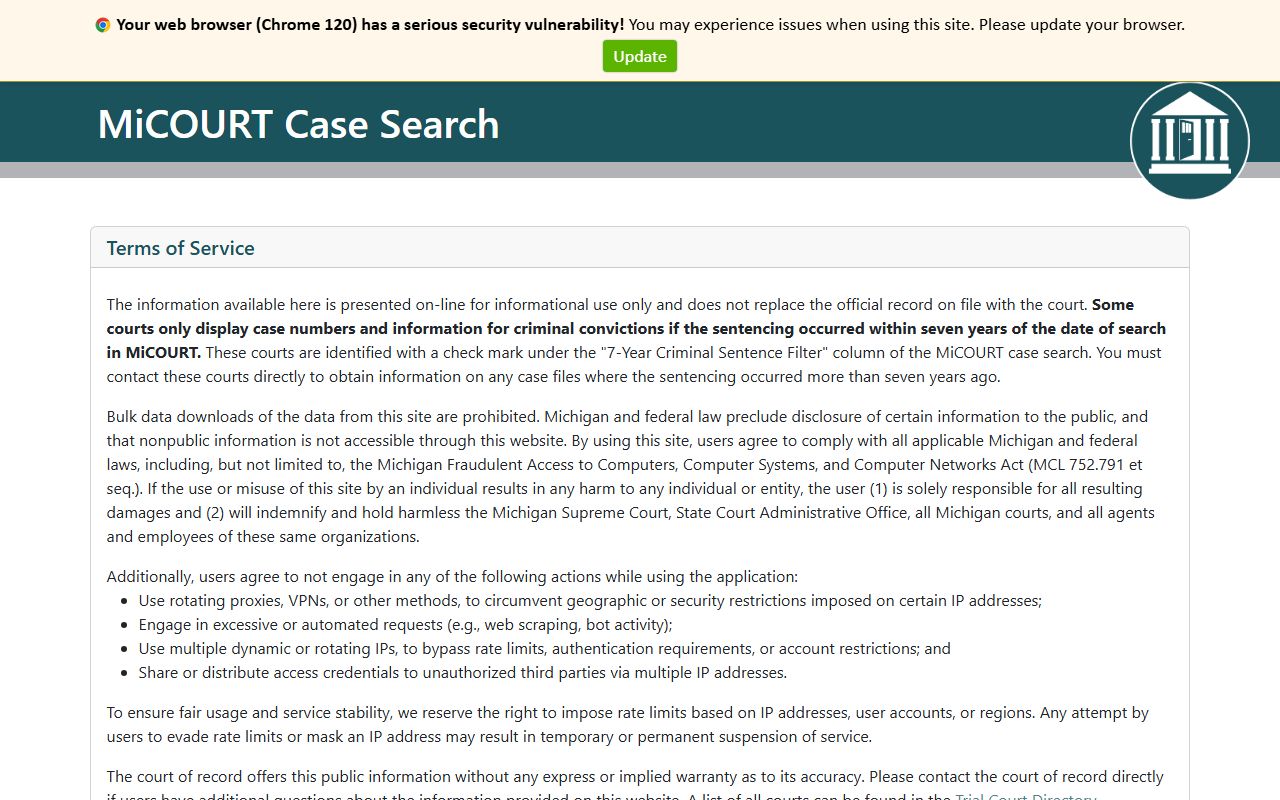
Use that portal for prosecutor-filed charges and court activity, then use Charlevoix County's own docket and clerk contacts when the online index does not provide the document or date needed.
90th District Court, 33rd Circuit Court, and the Prosecutor
Charlevoix criminal cases usually begin in the District Court stage. The 90th District Court is at 301 State St., Charlevoix, MI 49720, and lists phone 231-547-7227. It handles misdemeanor criminal cases, most traffic violations, civil cases up to $25,000, landlord-tenant matters, small claims, and the preliminary stages of felony cases. Arraignment occurs there for many misdemeanor and felony matters after a jail arrest.
The 33rd Circuit Court, also at 301 State St., handles felony criminal matters after bindover, along with other higher-level case types. The court lists phone 231-547-7243 and email circuitcourt@charlevoixcounty.org. The Charlevoix County Prosecuting Attorney is the office that represents the State of Michigan in criminal prosecutions in Circuit and District Court. The office address is 301 State St., Charlevoix, MI 49720; email is prosecutor@charlevoixcounty.org; phone is 231-547-7207. Christopher "Kit" Tholen is listed as the Prosecuting Attorney.
The local docket page is useful for near-term hearing checks. It should not be treated as a complete criminal-history system because docket dates can change and some files or documents may require the court counter, clerk review, or a certified-copy request.
Charlevoix County's court dockets page shows the local date-specific docket links that supplement MiCOURT.
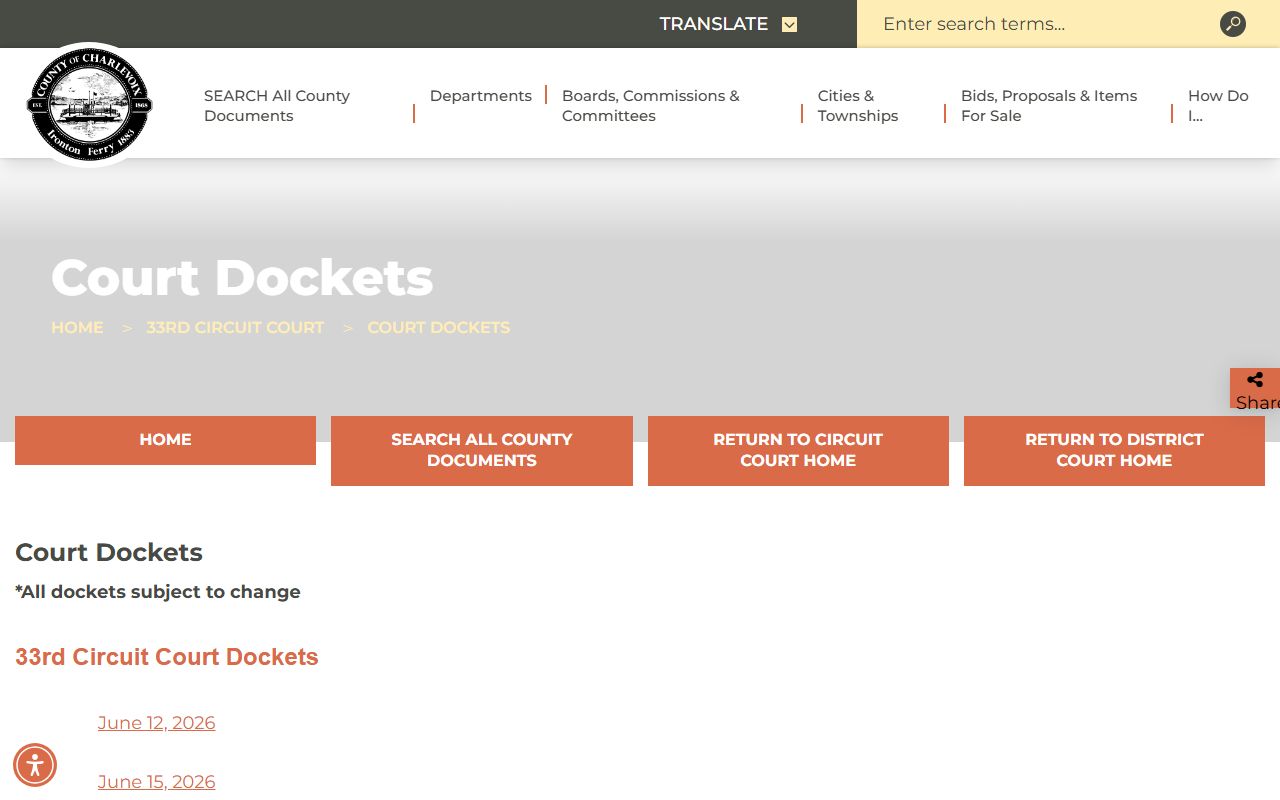
Because the county warns that dockets may change, confirm important appearance dates directly with the listed court before relying on a posted docket entry.
How Charges Get Filed After an Arrest: Complaint, Information, and Indictment
The first formal charging document described in the county prosecutor's adult criminal-case material is the Complaint. At arraignment, the defendant is told the charges and maximum penalties and is advised of rights. For misdemeanors, the defendant may plead guilty, not guilty, or stand mute at arraignment. For felonies, the defendant first appears in District Court, is advised of the right to a preliminary examination within 14 days, and generally does not enter a guilty or not-guilty plea at the District Court felony arraignment.
If a felony proceeds after a preliminary examination or waiver, it may be bound over to Circuit Court. At that stage, the charging document is commonly called an Information. An indictment is less central to the local process described in the Charlevoix prosecutor materials, but it is a charging document issued through a grand-jury process in systems where that method is used.
| Document | Who Files or Issues It | Common Role | What to Check |
|---|---|---|---|
| Complaint | Prosecutor after police charging or warrant request | Initial District Court charging document for misdemeanor and felony arraignment stages | Charge names, maximum penalties, case number, arraignment date, and bond terms |
| Information | Prosecutor | Felony charging document after bindover to Circuit Court | Whether charges changed after preliminary examination or waiver |
| Indictment | Grand jury | Alternative way to initiate serious criminal charges where used | Counts, offense dates, and whether it replaces an earlier charging path |
Charge Status in Court Records After an Arrest
Booking charges are a snapshot of the arrest basis. Court charges are the prosecutor-filed allegations that move through the court case. In Charlevoix County, the prosecutor may authorize a charge, amend it, reduce it, add a different count, dismiss it, or decline to proceed. That is why a jail intake notation and a MiCOURT case entry can disagree. The court record after a jail arrest is the better source for the current legal posture.
| Status | What It Means | Why It Matters |
|---|---|---|
| Pending | The charge is open and has not reached final disposition. | Check upcoming dates, bond conditions, and any amended filings. |
| Authorized | The prosecutor has approved a formal charge for filing. | The case has moved beyond the arresting officer's proposed charge. |
| Amended / Reduced | The filed charge was changed to a different or lower offense. | The final court charge may not match the booking record. |
| Dismissed | The court case or count was ended without a conviction on that charge. | Dismissal is not the same as automatic expungement or removal from every record system. |
| Bound Over | A felony case moved from District Court to Circuit Court after preliminary proceedings. | Search both court stages if the case appears split between District and Circuit entries. |
| Convicted | The defendant was found guilty or entered a plea accepted by the court. | Sentencing, probation, jail, or MDOC custody information may follow. |
Bond and Release After an Arrest
At arraignment, the judge determines bond amount and conditions. The Charlevoix prosecutor's page says the defendant is advised of the charges and rights, then bond is addressed. Conditions can include no contact with a victim or other court-ordered restrictions. The Sheriff's Inmate Trust Accounts page supplies the local payment detail: before posting bond in the jail lobby, a person must check in with staff at the jail receptionist's window. The public lobby kiosk is available 24 hours a day. The county page reports a $2 ATM fee for kiosk cash transactions and a 10% fee for credit or debit card transactions, including online JailATM deposits.
| Bond Type | How It Works |
|---|---|
| Cash Bond | Money is posted directly toward release, subject to the court's conditions and any other holds. |
| Surety Bond | A surety or bail agent posts bond where the court permits that method. |
| Personal Recognizance | The defendant is released on a promise to appear without posting the full cash amount. |
| Conditional Bond | Release depends on court restrictions such as no-contact, alcohol, drug, travel, or weapons conditions. |
| No-Bond Hold | Payment will not release the person if another warrant, parole or probation hold, immigration detainer, or outside-agency hold controls custody. |
Warrants That Lead to an Arrest
No official Charlevoix County active warrant list or public warrant-search portal was found on the sheriff or court sites reviewed. The Prosecuting Attorney's process explains that many cases begin with a warrant request. Police submit the request, the Prosecutor decides whether a person should be charged and what charge should be filed, and a warrant may issue when the suspect is not already in custody. If the person's location is unknown or the person leaves Michigan, the delay before arrest can vary.
For local warrant questions, call the Charlevoix County Sheriff's Office or jail at 231-547-4461 for custody routing, contact 90th District Court at 231-547-7227 for misdemeanor, traffic, arraignment, or District Court bench-warrant questions, and contact 33rd Circuit Court at 231-547-7243 for felony Circuit Court warrant or case questions. MiCOURT may show public case history, but a FOIA request is not a safe way to clear a warrant. Legal advice should come from an attorney, especially before walking in on an active warrant.
Charges vs. Convictions in Court Records
An arrest and a charge are accusations. A conviction is a final adjudication through plea or verdict. Public court records can show both, but the distinction matters for employment, housing, licensing, immigration, and personal decision-making. Do not treat an open charge or dismissed count as proof that the person was convicted.
| Charge | Conviction | |
|---|---|---|
| Stage | Accusation filed by the prosecutor after arrest review | Final finding of guilt or accepted guilty/no-contest plea |
| Proof Level | Probable cause and charging review | Beyond a reasonable doubt or plea accepted by the court |
| Record Meaning | Shows what was alleged and how the case moved | Shows the offense of conviction and sentencing consequences |
| Possible Outcome | Can be amended, reduced, dismissed, or bound over | Can lead to sentence, probation, jail, prison, fines, costs, or later set-aside review |
Sealed vs. Expunged Arrest and Court Records
Michigan public access rules and expungement laws can limit what appears in public-facing court and law-enforcement systems. The research sources identify Michigan FOIA as the general public-records framework, while also noting that exemptions and public-access limits apply. A dismissal, acquittal, or eligible set-aside does not automatically make every old webpage, private database, or copied booking notation disappear.
| Sealed or Nonpublic | Set Aside / Expunged | |
|---|---|---|
| Public Visibility | Hidden or restricted from normal public access under a court rule, statute, or order | Treated under Michigan set-aside law as no longer publicly available in the same way, subject to statutory exceptions |
| Law Enforcement | May retain limited access for authorized purposes | May retain restricted access where Michigan law allows |
| How It Happens | By court rule, statute, order, juvenile confidentiality, or other access restriction | Through eligibility and a set-aside or automatic process where applicable |
| Practical Step | Ask the court clerk what public documents are available | Use official court or legal resources to determine eligibility before assuming removal |
Public Access Limits and FOIA for Court Records After an Arrest
Michigan FOIA, MCL 15.231, declares a public policy favoring full and complete information about government affairs and official acts, subject to statutory limits. MCL 15.235 describes the public body's response choices, including grant, denial, partial grant and denial, or extension within the statutory response process. For law-enforcement records held by the Sheriff's Office, use the Sheriff's FOIA channel. For court case documents, start with MiCOURT, the local court, or the clerk because court records and sheriff records are not the same file.
Restricted records can include juvenile matters, sealed records, documents withheld by court rule, information tied to ongoing investigations, victim-protective information, and records affected by statutory exemptions. Charlevoix County also has a county FOIA coordinator split: law-enforcement FOIA routes through the Sheriff's Office, while non-law-enforcement county FOIA routes through the County Clerk structure.
FCRA notice: Charlevoix County Inmate Population is not a consumer reporting agency, and these records may not be used for credit, employment, tenant, insurance, or other FCRA-regulated decisions.